
 Tally Prime with GST
 AutoCAD 2D and 3D (Civil Design)
 AutoCAD 2D and 3D (Mechanical Design)
 Revit Architecture (CAD / BIM)
 Creo (CAD / Mechanical Design)
 SolidWorks (CAD / Mechanical Design)
 Electronic CAD (ECE)
 Diploma in Hardware and Networking
 PGDCA
 Ethical Hacking
 Computer Hardware and System Administrator
 Networking N+
 Microsoft Windows Server
 The Red Hat Certified System Administrator
 CCNA and CCNP
 Advanced Java
 Java
 Python
 C&C++
 PHP
 Javascript
 CSS
 HTML
 Bootstrap
 Angular JS
 Java Full Stack
 Python Full-Stack
 SQL
 Data analytics
 Power BI
 Excel with AI
 Robotics
 PLC & SCADA
 Microsoft Office (Or) Office Automation
 Advanced Excel
 Photoshop
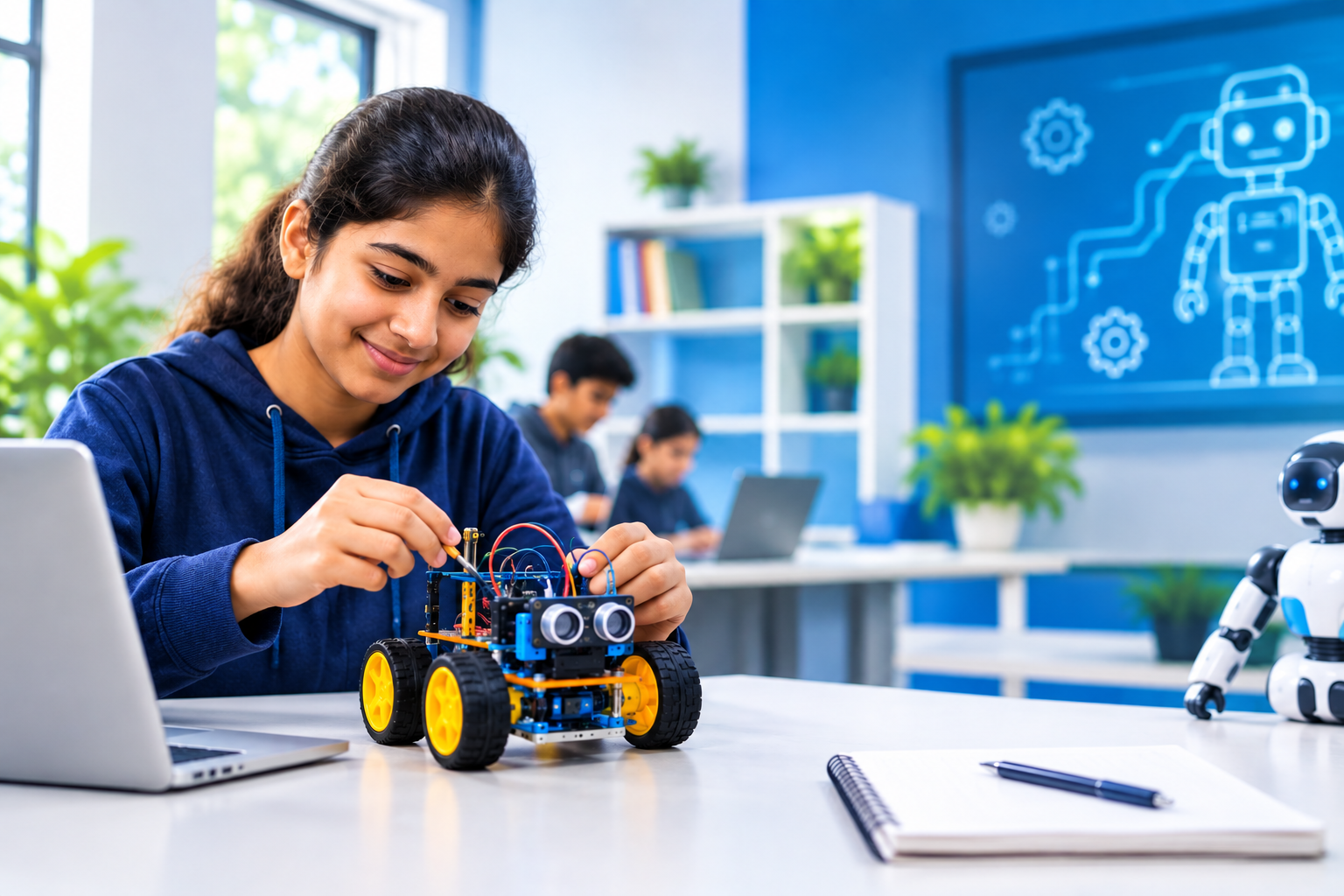
Artificial Intelligence, automation, smart devices, autonomous machines, and robotics are becoming part of everyday life. As industries continue to adopt these technologies, students are also looking for practical skills that can prepare them for the future.
Among these emerging skills, robotics is becoming increasingly important.
Robotics is no longer only about building small machines or programming robots to move forward and backward.
Modern robotics combines:
Programming + Electronics + Sensors + Automation + Artificial Intelligence + Problem Solving
This makes robotics one of the most interesting technology fields for students in 2026.
What Exactly Is Robotics?
Robotics is the field of technology that focuses on designing, building, programming, and controlling machines that can perform tasks automatically or with human assistance.
A robotic system usually combines both hardware and software.
Hardware can include:
- Motors
- Sensors
- Microcontrollers
- Robotic arms
- Wheels
- Cameras
- Batteries
- Mechanical components
Software can include:
- Programming
- Control logic
- Computer vision
- Artificial Intelligence
- Automation algorithms
When these components work together, a robot can sense its environment and perform specific actions.
Why Is Robotics Becoming Important in 2026?
The world is moving toward greater automation.
Businesses want to improve productivity, reduce repetitive work, increase accuracy, and make dangerous tasks safer.
Robots can help with many of these challenges.
They can be used for:
- Manufacturing
- Warehouse automation
- Healthcare
- Agriculture
- Logistics
- Research
- Education
- Inspection
- Security
- Smart environments
As robotics becomes connected with AI, robots are also becoming capable of handling more complex tasks.
This is creating new opportunities for people with robotics-related skills.
Robotics Is Not Just About Building Robots
Many students initially think robotics means assembling a robot and making it move.
That is only the beginning.
A complete robotics project can involve several different areas.
For example:
Design → Electronics → Sensors → Programming → Testing → Automation → AI → Real-World Application
A student building an autonomous robot may need to understand how the robot detects obstacles, processes sensor information, makes decisions, and controls its motors.
This makes robotics a practical way to understand how different technologies work together.
How Robotics Helps Students Learn Programming
Programming is one of the most important parts of robotics.
A robot needs instructions to determine:
- What should it do?
- When should it move?
- How should it respond to a sensor?
- What should happen when an obstacle is detected?
- How should it react to a change in the environment?
Instead of learning programming only through theoretical examples, robotics allows students to see the result of their code in the physical world.
For example:
If distance < threshold → Stop → Turn → Continue
A simple programming concept can immediately become a real-world robotic behaviour.
This makes learning more interactive and practical.
Sensors: How Robots Understand Their Environment
A robot cannot make useful decisions without information.
Sensors provide that information.
Depending on the project, a robot may use sensors to detect:
- Distance
- Light
- Temperature
- Motion
- Sound
- Pressure
- Position
- Obstacles
For example, an obstacle-avoiding robot can use distance sensors to detect an object in front of it.
The programming logic can then decide what the robot should do.
This teaches students an important concept:
Input → Processing → Output
Sensors provide the input.
The program processes the information.
Motors or other components produce the output.
Robotics and Artificial Intelligence
Artificial Intelligence is changing what robots can do.
Traditional robots generally perform predefined actions.
AI-powered robotic systems can potentially analyse information and make more intelligent decisions.
For example, computer vision can help a robot identify an object.
Machine learning can help systems improve their performance based on data.
AI can also support:
- Object recognition
- Navigation
- Decision-making
- Voice interaction
- Prediction
- Autonomous behaviour
This is why learning robotics alongside AI can be valuable for students interested in future technologies.
Robotics Makes Learning More Practical
One major advantage of robotics education is hands-on learning.
Instead of only reading about:
- Motors
- Sensors
- Programming
- Circuits
- Automation
Students can actually build and test systems.
A project may fail.
The sensor may not work correctly.
The motor may rotate in the wrong direction.
The program may contain an error.
The robot may not behave as expected.
These problems become learning opportunities.
Students learn how to analyse the problem, identify the cause, modify the system, and test it again.
Robotics Develops Problem-Solving Skills
Robotics is not always about getting the first attempt right.
In many projects, students need to experiment.
They may ask:
Why is the robot not detecting the obstacle?
Why is the motor moving too slowly?
Why is the sensor giving incorrect readings?
Why is the robot turning in the wrong direction?
Answering these questions develops logical thinking and problem-solving skills.
These skills are useful far beyond robotics.
Robotics Encourages Creativity
Robotics does not have only one correct project.
Students can design robots for different purposes.
For example:
- Smart dustbin
- Line-following robot
- Obstacle-avoiding robot
- Automatic plant monitoring system
- Smart home prototype
- Robotic arm
- Autonomous vehicle prototype
Students can take the same basic components and create completely different solutions.
This combination of engineering and creativity makes robotics an engaging learning experience.
Robotics and STEM Education
Robotics naturally connects several STEM subjects.
Science
Students can explore concepts such as motion, energy, force, and sensors.
Technology
They learn about controllers, automation, AI, and digital systems.
Engineering
They design, build, test, and improve physical systems.
Mathematics
Measurements, angles, speed, distance, and calculations are often part of robotic projects.
Because robotics connects multiple subjects, it can help students understand how classroom concepts are applied in real-world technology.
What Skills Can Students Develop Through Robotics?
A good robotics learning journey can help students develop several technical and personal skills.
Programming
Understanding logic, conditions, loops, functions, and control systems.
Electronics
Learning about circuits, components, sensors, and controllers.
Mechanical Understanding
Understanding movement, structure, balance, and mechanical design.
Automation
Learning how machines can perform tasks automatically.
Artificial Intelligence
Exploring how intelligent systems can analyse information and make decisions.
Teamwork
Many robotics projects are easier when students work together.
Problem Solving
Students learn to identify problems and develop practical solutions.
Robotics Can Prepare Students for Future Technology Careers
Robotics knowledge can provide a foundation for exploring several technology fields.
Students interested in robotics may later explore areas such as:
- Robotics Engineering
- Automation Engineering
- Embedded Systems
- Artificial Intelligence
- Machine Learning
- Computer Vision
- Mechatronics
- Industrial Automation
- Autonomous Systems
- Drone Technology
Robotics does not necessarily lock a student into one career.
Instead, it introduces them to several interconnected technology domains.
Robotics Projects Can Build a Strong Student Portfolio
Learning is more valuable when students can demonstrate what they have built.
A robotics project can become part of a student's technology portfolio.
For example, a student could document:
Project Idea → Design → Components → Programming → Testing → Challenges → Final Result
This can help demonstrate practical knowledge rather than only theoretical understanding.
For students preparing for higher education or future technology careers, project-based learning can be particularly useful.
Why Start Learning Robotics Early?
Students do not necessarily need to wait until college to explore robotics.
Starting early can help them become familiar with:
- Programming logic
- Electronics
- Sensors
- Automation
- Engineering concepts
- Technology problem solving
Early exposure can also help students discover which areas of technology they enjoy most.
A student who starts with a simple robot may eventually become interested in AI, embedded systems, automation, or engineering.
The Future of Robotics
Robotics is expected to continue evolving.
Future robotic systems may become:
- More autonomous
- More intelligent
- More energy efficient
- Better at understanding environments
- Safer around humans
- More capable of complex tasks
The combination of robotics with AI could create machines that are increasingly capable of operating in dynamic environments.
This does not mean robots will suddenly perform every human task.
Instead, robotics will likely continue expanding the range of tasks that machines can assist with.
Is Robotics Difficult to Learn?
Robotics may look complicated when viewed as a complete system.
But students can learn it step by step.
A typical learning journey can begin with:
Basic Electronics → Programming → Sensors → Motors → Microcontrollers → Robot Building → Automation → AI
Students do not need to understand everything on the first day.
The important thing is to build a strong foundation and gradually move toward more advanced projects.
Why Hands-On Training Matters
Robotics is a practical technology.
Reading about a motor is different from controlling one.
Reading about a sensor is different from connecting one.
Reading about automation is different from building an automated system.
Hands-on training allows students to understand how different components work together.
This practical experience can make technical concepts easier to understand and remember.
Should Students Learn Robotics in 2026?
If you are interested in programming, engineering, electronics, Artificial Intelligence, or emerging technologies, robotics can be an excellent skill to explore in 2026.
The biggest advantage is that robotics does not teach only one technology.
It teaches students how multiple technologies can work together to solve real-world problems.
For students searching for a Robotics Course in Trichy, learning through practical projects can provide a strong starting point for understanding programming, electronics, automation, and intelligent systems.
Final Thoughts
Robotics is becoming an important part of the future of technology.
But the real value of robotics education is not simply learning how to build a robot.
It is learning how to:
Think → Design → Program → Test → Solve → Improve
These skills can help students become better problem solvers and prepare them for a technology-driven future.
As Artificial Intelligence and automation continue to develop, the ability to understand both software and physical systems can become increasingly valuable.
The future belongs not only to people who use technology.
It belongs to people who understand how technology works and know how to build solutions with it.
For students, robotics can be the beginning of that journey.
Learn. Build. Experiment. Innovate.
Start with a simple idea, build a working system, learn from every mistake, and gradually explore the exciting world of robotics.




Comments (0)
No comments available.