
 Tally Prime with GST
 AutoCAD 2D and 3D (Civil Design)
 AutoCAD 2D and 3D (Mechanical Design)
 Revit Architecture (CAD / BIM)
 Creo (CAD / Mechanical Design)
 SolidWorks (CAD / Mechanical Design)
 Electronic CAD (ECE)
 Diploma in Hardware and Networking
 PGDCA
 Ethical Hacking
 Computer Hardware and System Administrator
 Networking N+
 Microsoft Windows Server
 The Red Hat Certified System Administrator
 CCNA and CCNP
 Advanced Java
 Java
 Python
 C&C++
 PHP
 Javascript
 CSS
 HTML
 Bootstrap
 Angular JS
 Java Full Stack
 Python Full-Stack
 SQL
 Data analytics
 Power BI
 Excel with AI
 Robotics
 PLC & SCADA
 Microsoft Office (Or) Office Automation
 Advanced Excel
 Photoshop

Robotics is no longer limited to science-fiction movies, research laboratories, or simple industrial machines. In 2026, robots are becoming more intelligent, more autonomous, and increasingly capable of interacting with real-world environments.
Artificial Intelligence is playing a major role in this transformation.
From factories and warehouses to healthcare, logistics, education, and smart environments, robots are moving beyond simple programmed instructions and beginning to understand their surroundings, make decisions, and perform increasingly complex tasks.
This has created an important question among students, engineers, technology enthusiasts, and businesses:
Are we entering the age of intelligent robots?
The short answer is yes - but the biggest change is not simply the rise of robots.
It is the combination of Robotics + Artificial Intelligence + Sensors + Computer Vision + Physical AI.
The Traditional Way of Robotics
Traditional robots were generally designed to perform specific tasks in controlled environments.
A robot could be programmed to:
- Pick and place objects
- Assemble products
- Move materials
- Perform repetitive manufacturing tasks
- Follow predefined paths
- Perform inspection activities
These robots are extremely useful because they can perform repetitive tasks with consistency and precision.
However, traditional robots often depend heavily on predefined instructions.
If the environment changes significantly, the robot may require new programming or adjustments.
This is where Artificial Intelligence is beginning to change robotics.
How AI Is Changing Robotics
AI is helping robots move from simple automation toward intelligent decision-making.
Modern robotic systems can combine:
- Computer Vision
- Machine Learning
- Artificial Intelligence
- Sensors
- Motion Planning
- Natural Language Processing
- Reinforcement Learning
- Robotics Control Systems
Instead of simply following a fixed sequence, AI-powered robots can increasingly analyse their environment and respond to changing situations.
For example, a warehouse robot may need to identify an object, understand its location, plan a path, avoid obstacles, and move the object to another location.
AI can help coordinate several of these processes.
This is one reason why Physical AI is becoming an important concept in modern robotics.
What Is Physical AI?
Traditional AI mainly works with digital information such as text, images, audio, and data.
Physical AI extends intelligence into the physical world.
A physically intelligent robot needs to:
See → Understand → Decide → Move → Interact → Adapt
This requires the combination of AI models with physical hardware, sensors, actuators, cameras, and control systems.
Industry research in 2026 increasingly highlights physical AI and embodied intelligence as important directions for the future of robotics.
The Rise of Humanoid Robots
One of the biggest robotics trends attracting worldwide attention is the development of humanoid robots.
Humanoid robots are designed with a human-like body structure that may include:
- Two arms
- Two legs
- Hands
- Cameras and sensors
- A central computing system
- AI-based control
The idea is simple:
If humans have already designed homes, factories, warehouses, offices, and tools around the human body, robots with similar physical capabilities may be able to operate in these environments without completely redesigning them.
However, humanoid robotics is still developing.
Challenges such as energy consumption, dexterity, safety, reliability, cost, and real-world adaptability remain important.
How Robots Are Learning to See
A robot cannot intelligently interact with the world without understanding what is around it.
This is where Computer Vision becomes important.
Cameras and other sensors can help robots identify:
- Objects
- People
- Obstacles
- Surfaces
- Movement
- Distance
- Environmental changes
Modern robotics increasingly combines visual perception with other sensor information to create a better understanding of the environment.
This allows robots to perform tasks that require more than simple movement.
For example, a robot could identify an object on a table, estimate its position, and determine how its robotic arm should approach it.
From Commands to Goals
Another major change is the shift from robots following individual commands toward robots completing higher-level goals.
Imagine telling a robot:
“Move these packages to the storage area.”
A traditional system may require a carefully programmed sequence.
An AI-powered robotic system can potentially break the task into smaller actions:
Identify packages → Plan route → Navigate → Pick objects → Avoid obstacles → Reach destination → Place objects
This type of goal-oriented behaviour is one of the reasons vision-language-action systems and embodied AI are receiving increasing attention in robotics research.
Where Are Intelligent Robots Being Used?
Robotics is already being applied across multiple industries.
Manufacturing
Robots can support:
- Assembly
- Welding
- Inspection
- Material handling
- Packaging
- Quality control
Warehousing and Logistics
Robots can help with:
- Transportation
- Sorting
- Picking
- Inventory movement
- Warehouse navigation
Healthcare
Robotics is being explored for:
- Robotic surgery
- Rehabilitation
- Assistive technologies
- Elderly care
- Medical logistics
Healthcare robotics is also identified as an important area of continued development.
Agriculture
Robotics can support:
- Crop monitoring
- Automated harvesting
- Weed detection
- Field inspection
- Precision agriculture
Education
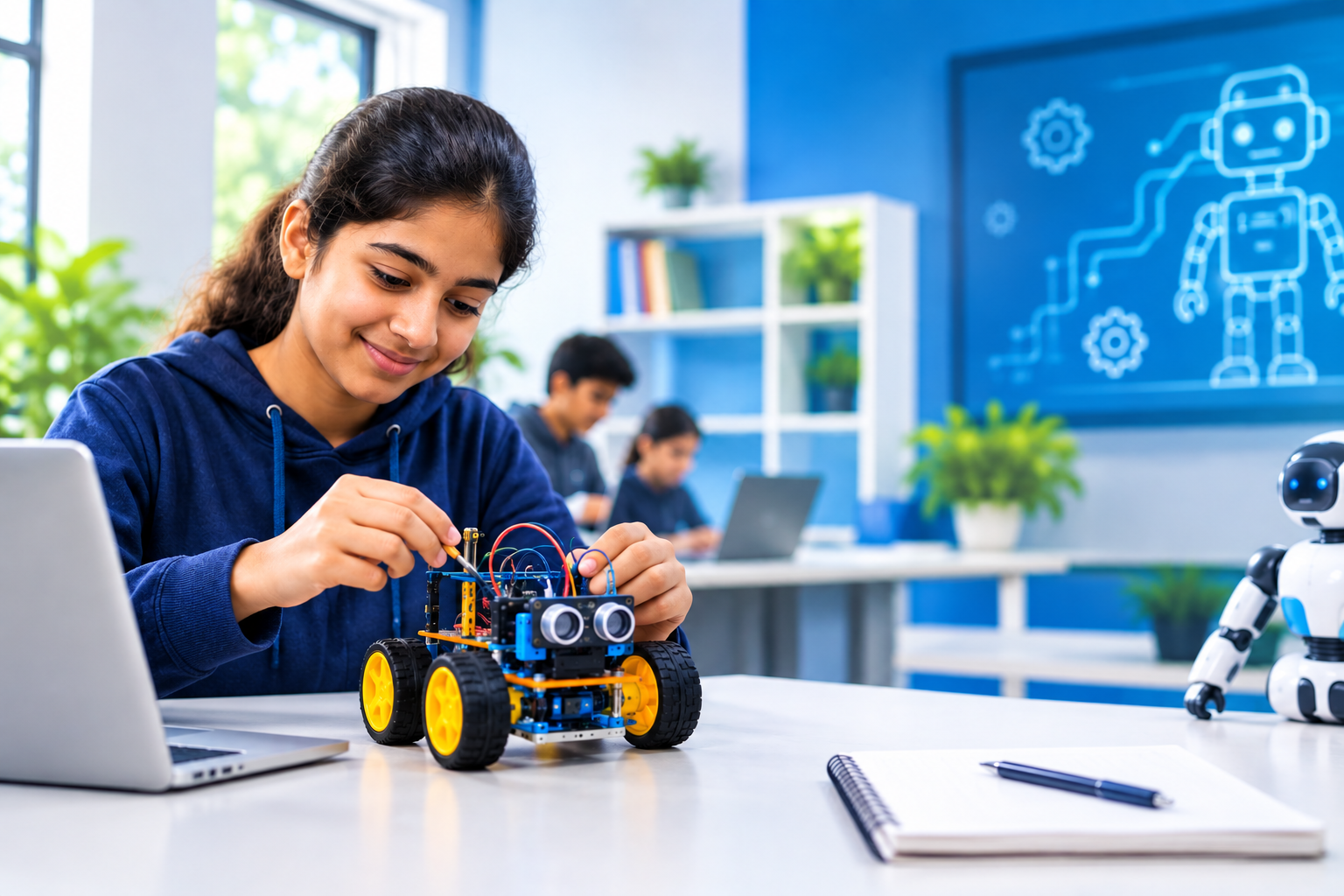
Robotics is becoming an exciting learning platform for students.
Students can learn concepts such as:
- Electronics
- Programming
- Sensors
- Automation
- Artificial Intelligence
- Problem solving
- Mechanical systems
This makes robotics particularly valuable for students who want practical exposure to technology.
Robots and Human Collaboration
The future of robotics is not necessarily about robots replacing every human task.
Instead, an important direction is Human-Robot Collaboration.
Robots can handle:
- Repetitive work
- Dangerous environments
- Heavy lifting
- Continuous monitoring
- Highly repetitive processes
Humans can focus on:
- Creativity
- Decision-making
- Problem solving
- Strategy
- Communication
- Complex judgement
This combination can create safer and more productive working environments.
Why Sensors Are So Important in Robotics
A robot needs more than a motor and a program.
It needs information about the world.
Sensors can provide information about:
- Distance
- Position
- Movement
- Temperature
- Pressure
- Light
- Touch
- Orientation
Modern robots may combine multiple sensors to understand their surroundings.
Better perception can lead to better navigation, safer interaction, and more accurate manipulation.
This is why perception and sensor fusion are becoming fundamental parts of modern physical AI systems.
The Role of Simulation in Robotics
Training a physical robot in the real world can be expensive and sometimes dangerous.
Simulation provides a different approach.
Robots can be trained or tested in virtual environments before being deployed into physical environments.
Simulation can help developers experiment with:
- Navigation
- Object manipulation
- Motion planning
- Reinforcement learning
- Robot behaviour
- Different environmental conditions
However, simulation does not perfectly reproduce every real-world situation.
The difference between simulation and reality remains an important robotics challenge.
What Skills Are Becoming Important in Robotics?
Students interested in robotics should not focus only on building a simple robot.
Modern robotics combines multiple technology areas.
Important skills include:
Programming
Programming helps control robotic behaviour and develop intelligent applications.
Electronics
Understanding circuits, controllers, motors, and sensors is fundamental.
Sensors
Students should understand how robots collect information from their environment.
Robotics Control
Control systems help robots perform accurate and stable movements.
Computer Vision
Computer vision allows robots to interpret visual information.
Artificial Intelligence
AI can help robots learn, recognise objects, make decisions, and adapt.
Problem Solving
Robotics is ultimately about solving real-world problems using technology.
Robotics Is Becoming More Than Automation
The biggest change in robotics is the movement from:
Automation → Intelligence → Adaptation
Traditional automation focuses on repeating predefined tasks.
Modern intelligent robotics aims to understand the environment, make decisions, and adapt to changing situations.
This does not mean every robot will suddenly become completely autonomous.
Instead, robotics is evolving step by step toward systems that can operate more intelligently in real-world environments.
What Does This Mean for Students?
For students interested in technology, robotics can provide a strong foundation for learning multiple modern technologies.
A robotics project can involve:
Idea → Electronics → Sensors → Programming → Mechanical Design → AI → Testing → Real-World Application
This makes robotics an interdisciplinary field.
Students can learn how hardware and software work together rather than studying technology concepts only from theory.
For students searching for Robotics Training in Trichy, learning robotics can also provide practical exposure to programming, electronics, automation, sensors, and AI-related concepts.
The Future of Robotics
The future of robotics is likely to involve several technologies working together.
We can expect continued development in:
- Humanoid Robotics
- Physical AI
- Embodied AI
- Autonomous Mobile Robots
- Healthcare Robotics
- Industrial Automation
- Robot Vision
- Human-Robot Collaboration
- Robot Learning
- Advanced Manipulation
Industry organisations and research communities are increasingly identifying embodied AI, humanoid robotics, healthcare robotics, dexterous manipulation, and human-robot collaboration as important areas for the coming years.
Will Robots Replace Humans?
This is one of the biggest questions surrounding robotics.
The reality is more complicated.
Robots are very good at certain tasks, particularly those that are repetitive, dangerous, predictable, or physically demanding.
But humans continue to have important advantages in areas such as creativity, social understanding, complex reasoning, adaptability, and decision-making.
The more realistic future may therefore be:
Humans + Robots working together.
The goal is not necessarily to replace every human worker.
It is to use robotics to improve productivity, safety, efficiency, and the ability to perform difficult tasks.
Should Students Learn Robotics in 2026?
If you are interested in technology, engineering, programming, electronics, automation, or Artificial Intelligence, 2026 is an exciting time to explore robotics.
But learning robotics should go beyond simply assembling a robot.
Students should understand:
- How sensors work
- How motors are controlled
- How robots perceive environments
- How programming controls behaviour
- How AI can improve robotic systems
- How robots solve real-world problems
Building strong fundamentals first and then exploring AI-powered robotics can create a much stronger learning foundation.
Final Thoughts
Robotics is entering a new phase.
The future is no longer only about machines that repeat programmed movements.
It is increasingly about machines that can perceive, understand, learn, plan, and act in the physical world.
AI, computer vision, sensors, simulation, and advanced control systems are coming together to create a new generation of intelligent robots.
Humanoid robots may attract the headlines, but the broader robotics revolution is happening across factories, warehouses, hospitals, logistics, agriculture, and many other industries.
For students and aspiring engineers looking for a Robotics Course in Trichy, this is an excellent time to start building practical knowledge and understand how robotics is evolving alongside Artificial Intelligence.
The future of robotics may not be:
Robots vs Humans.
It may be:
Robots + Humans creating a smarter, safer, and more automated world.
Learn. Build. Program. Innovate.
With platforms such as METS Computer, students interested in robotics can explore practical technology concepts while developing the programming, electronics, automation, and problem-solving skills needed for the future of intelligent robotics.




Comments (0)
No comments available.